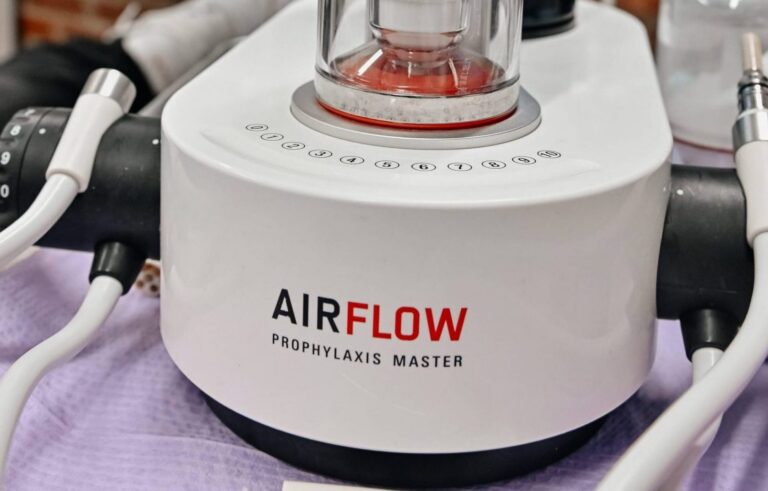
AirFlow® teeth cleaning uses a controlled stream of air, warm water, and fine powder to remove dental biofilm and many surface stains, while traditional cleaning typically uses scaling instruments followed by polishing. Both approaches can play an important role in professional dental care, but AirFlow technology may provide a gentler and more comfortable experience for many patients.
If you've ever left a dental cleaning wishing there were a more comfortable way to remove buildup and stains, AirFlow may be worth asking about. At A Plus Dentistry in Brookline, MA, advanced dental technology allows us to personalize preventive care according to each patient's oral health needs.
AirFlow teeth cleaning is a professional dental hygiene technique that uses a carefully controlled combination of air, water, and fine powder directed at the surfaces of the teeth.
Rather than relying primarily on a rotating rubber cup and polishing paste to remove plaque biofilm and surface stains, air polishing directs a fine stream across the tooth surface.
Scientific literature describes air-polishing devices as using compressed air, water, and abrasive particles to disrupt and remove dental biofilm. Research has evaluated powders including glycine and erythritol for professional biofilm management.
The result can be a smooth, fresh feeling after your professional dental cleaning.
Dental biofilm, commonly known as dental plaque, is a sticky layer of bacteria that continuously forms on the teeth. According to the American Dental Association (ADA), plaque buildup can contribute to cavities and gum disease if it isn't regularly removed. Daily brushing and cleaning between the teeth are essential for controlling plaque, while professional biofilm removal can target buildup that may be more difficult to manage at home.
Traditional professional dental cleaning can involve several techniques depending on the patient's oral health.
A dentist or dental hygienist may use:
Scaling instruments are particularly important when calculus (tartar) needs to be removed.
Traditional professional cleaning may involve ultrasonic or hand instrumentation followed by polishing with a rubber cup and prophylaxis paste. Air polishing offers a different approach to professional biofilm removal, using air, water, and fine powder to clean tooth surfaces. A randomized clinical trial published in the International Journal of Dental Hygiene compared an erythritol air-polishing protocol with conventional ultrasonic debridement followed by rubber-cup polishing, supporting air polishing as an effective option for professional biofilm management.
The key difference between the two approaches is how they remove biofilm, stains, and deposits.
Traditional cleaning may use hand or ultrasonic scaling to remove hard deposits such as calculus, followed by polishing to address residual plaque and certain surface stains.
AirFlow focuses on removing biofilm and extrinsic staining using air, water, and fine powder. It can be particularly useful for reaching areas where biofilm may be more difficult to remove efficiently with conventional polishing alone.
However, AirFlow doesn't replace every instrument used during a dental cleaning. If you have significant hard calculus deposits, additional scaling may still be necessary.
Research has found that air polishing can be used for biofilm control in certain periodontal maintenance situations, with clinical effectiveness comparable to conventional approaches in selected applications.
The advantage isn't that traditional cleaning is ineffective. AirFlow simply provides another method of professional biofilm management that may offer additional comfort and convenience for certain patients.
One of the main advantages of AirFlow teeth cleaning is its ability to target biofilm across tooth surfaces.
The combination of air, water, and fine powder disrupts biofilm and washes it away while also helping remove extrinsic surface stains.
Common sources of surface staining include:
It's important to understand that AirFlow is not the same as professional teeth whitening.
AirFlow removes external staining and deposits from the tooth surface. Whitening treatments use bleaching agents to lighten the actual color of teeth.
Your teeth may therefore appear cleaner and brighter after AirFlow if surface stains were present, but the treatment isn't designed to change your natural tooth shade.
For many patients, comfort is one of the most appealing benefits of air polishing.
Instead of prolonged polishing with a rotating rubber cup, AirFlow uses a controlled stream across the tooth surface.
Research suggests that air polishing can provide clinical results comparable to conventional periodontal cleaning methods in supportive periodontal care, while offering potential advantages in patient comfort. A 2023 systematic review found that air polishing was associated with better patient-related outcomes and was considered a faster and more comfortable option for patients undergoing supportive periodontal therapy.
Individual experiences vary, however. If you have sensitive teeth, gum recession, active periodontal disease, or another oral health concern, tell your dental team before your cleaning so the procedure can be adapted to your needs.
AirFlow can be useful for many patients, but certain people may particularly appreciate its approach to biofilm and stain removal.
If you regularly drink coffee or tea, surface staining can gradually dull your smile.
Air polishing can remove many extrinsic stains, making it useful for patients who want their teeth to look and feel cleaner without undergoing a cosmetic whitening treatment.
Some people dislike the pressure, vibration, or sensation associated with traditional rubber-cup polishing.
Because AirFlow works differently, many patients may find the experience more comfortable.
Brackets and other orthodontic components can create areas that are challenging to clean thoroughly at home. Professional biofilm management can help address difficult-to-reach surfaces as part of an individualized dental hygiene plan.
You don't need visible staining to benefit from professional biofilm removal.
Controlling dental biofilm is an important part of maintaining healthy teeth and gums, making AirFlow relevant for patients who prioritize preventive dental care.
Air-polishing technology has also been studied in supportive periodontal therapy. Research suggests that air polishing can provide biofilm control comparable to conventional instrumentation in selected periodontal maintenance applications, with potential comfort benefits.
Your dentist or hygienist can determine which cleaning techniques are appropriate based on your gum health and the presence of calculus.
One of the most important things to understand is that biofilm and calculus are not the same.
Plaque biofilm is soft and can be disrupted through brushing, interdental cleaning, and professional biofilm removal. Calculus is hardened, mineralized buildup that requires professional removal.
Air polishing can be effective for biofilm management but has limitations when removing firmly attached calculus and other hard deposits.
For this reason, your professional dental cleaning may combine AirFlow with hand or ultrasonic scaling when necessary.
The goal isn't to choose technology simply because it's newer. The goal is to use the right combination of techniques for your individual oral health.
Neither method is automatically better for every patient.
Research comparing air polishing with conventional periodontal instrumentation has generally found similar clinical outcomes for biofilm control in selected periodontal maintenance applications rather than evidence that AirFlow universally replaces conventional techniques.
The best approach depends on factors such as:
For some patients, the most effective professional cleaning may involve both AirFlow and conventional instrumentation.
Your dentist or hygienist can recommend the approach that best matches your oral health needs.
Even advanced professional cleaning can't replace good daily oral hygiene.
To help control plaque between appointments:
Professional care works best when combined with consistent habits at home.
AirFlow teeth cleaning is a professional biofilm and stain-removal technique that uses a controlled stream of air, water, and fine powder across the surfaces of the teeth. It can be incorporated into a personalized professional dental cleaning.
AirFlow is primarily designed for biofilm and surface stain removal. Firmly attached calculus or tartar may require ultrasonic or hand scaling, so your dental team may combine different techniques during your appointment.
AirFlow can make teeth appear cleaner and brighter by removing certain external surface stains, but it isn't a bleaching treatment and doesn't change the natural internal shade of your teeth.
Many patients find air polishing comfortable. Research comparing air polishing with conventional periodontal instrumentation has reported favorable patient comfort outcomes, although individual experiences and dental needs vary.
Not necessarily. The best professional cleaning method depends on your teeth, gums, restorations, medical and dental history, and the type of deposits that need to be removed. Your dental team can determine whether AirFlow is appropriate for you.
AirFlow teeth cleaning and traditional cleaning are both valuable professional hygiene approaches, but they work differently. AirFlow uses air, water, and fine powder to remove dental biofilm and many external stains, while conventional cleaning may use hand or ultrasonic scaling and rubber-cup polishing. AirFlow may provide comfort advantages for some patients, but calculus can still require conventional scaling. Your dental professional can determine whether AirFlow, traditional techniques, or a combination is best for your smile.
If traditional polishing isn't your favorite part of a dental visit—or you're interested in an advanced approach to biofilm and surface stain removal—ask our team at A Plus Dentistry about AirFlow teeth cleaning.
We'll evaluate your oral health and recommend the professional cleaning techniques that best fit your individual needs.
📞 (617)264-9200
📍 320 Washington Street, Brookline, MA
Schedule your appointment today and discover whether AirFlow teeth cleaning is the right choice for a cleaner, fresher smile.
If you have any comments and or suggestions relating to improving the accessibility of our website, please don’t hesitate to contact us. Your feedback will help us make improvements.
Plan your visit today! Check out our office hours below